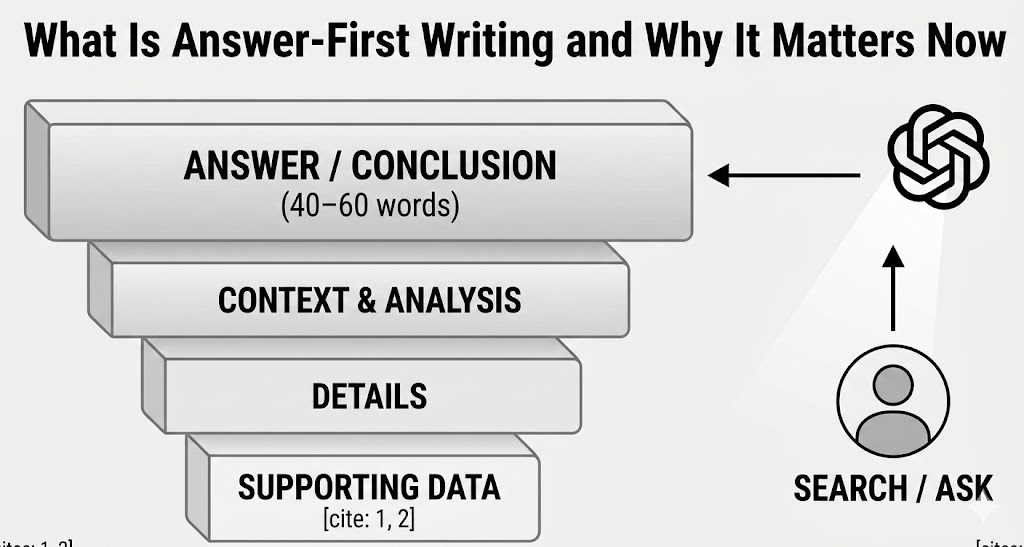
Answer‑first writing bridges classic SEO with LLM Optimization (LLMO): use keywords, headings and schema, but open every section with a direct answer in the first 40–60 words so humans and AI search engines like Perplexity, ChatGPT and Google AI Overviews can extract it instantly.
Answer‑first writing places the conclusion or answer upfront, followed by context, analysis and details in decreasing order of importance—adapting journalism's inverted pyramid for modern AI consumption. Every article and section delivers "what to do / choose / understand" in the first 1–3 sentences, skipping lengthy setups.
AI search has shifted traffic from "search → click → read" to "query → zero-click AI answer," forcing content to optimize for LLM reading, chunking and extraction beyond traditional SERPs. AI-referred traffic proves far more valuable than organic clicks, while storytelling-heavy SEO increasingly fails in AI Overviews environments.
Traditional SEO targets keyword density, backlinks and dwell time through narrative; AI search SEO (GEO/AEO) prioritizes extractability, structure, factual density and semantic clarity. LLMs evaluate content by meaning and parseability, favoring one-idea-per-section formats with explicit, repeated entities.
Essential transitions:
Transformer-based LLMs use self-attention and positional encoding (RoPE), making attention allocation position-dependent within context windows. Long contexts trigger computational shortcuts, prioritizing sequence starts/ends over middles, especially beyond pre-training lengths.
The "Lost in the Middle" effect proves retrieval accuracy peaks at prompt beginnings/ends and crashes when facts sit mid-context. This mirrors human primacy/recency bias, making front-loaded answers and facts optimal for both reader UX and model processing efficiency.
Apply answer-first across prompts, content outputs and RAG source documents for comprehensive AI search SEO.
answer, key_points, details, assumptions, sources).Reusable answer-first skeleton:
Standardize 2–3 templates across product specs, policies and educational content to institutionalize the approach.
This unified checklist from the research ensures SEO/AI search readiness:
Recommended visuals:

Zero UI is quietly reshaping how we search, make decisions, and engage with digital products in the zero-click era powered by AI agents. At platforms like Geolify.ai – a Generative Engine Optimization (GEO) platform – this shift isn’t just theoretical; it’s a fundamental change in how brands must position themselves to remain visible and selected. […]


AI Search is growing 165 times faster than organic search, yet the vast majority of search behavior still occurs on Google—where AI Overviews now appear on roughly one-fifth of all queries, reaching billions of users monthly. Coupled with AI Mode, this marks Google Search’s most significant pivot since the mobile era, forcing businesses to fundamentally […]

The digital information ecosystem is undergoing its most profound transformation since the dawn of the commercial internet. We have officially moved from the era of Information Retrieval—where users dig through lists of blue links—to the era of Information Synthesis, where AI agents read, reason, and provide direct answers. For businesses, this is not just a […]